
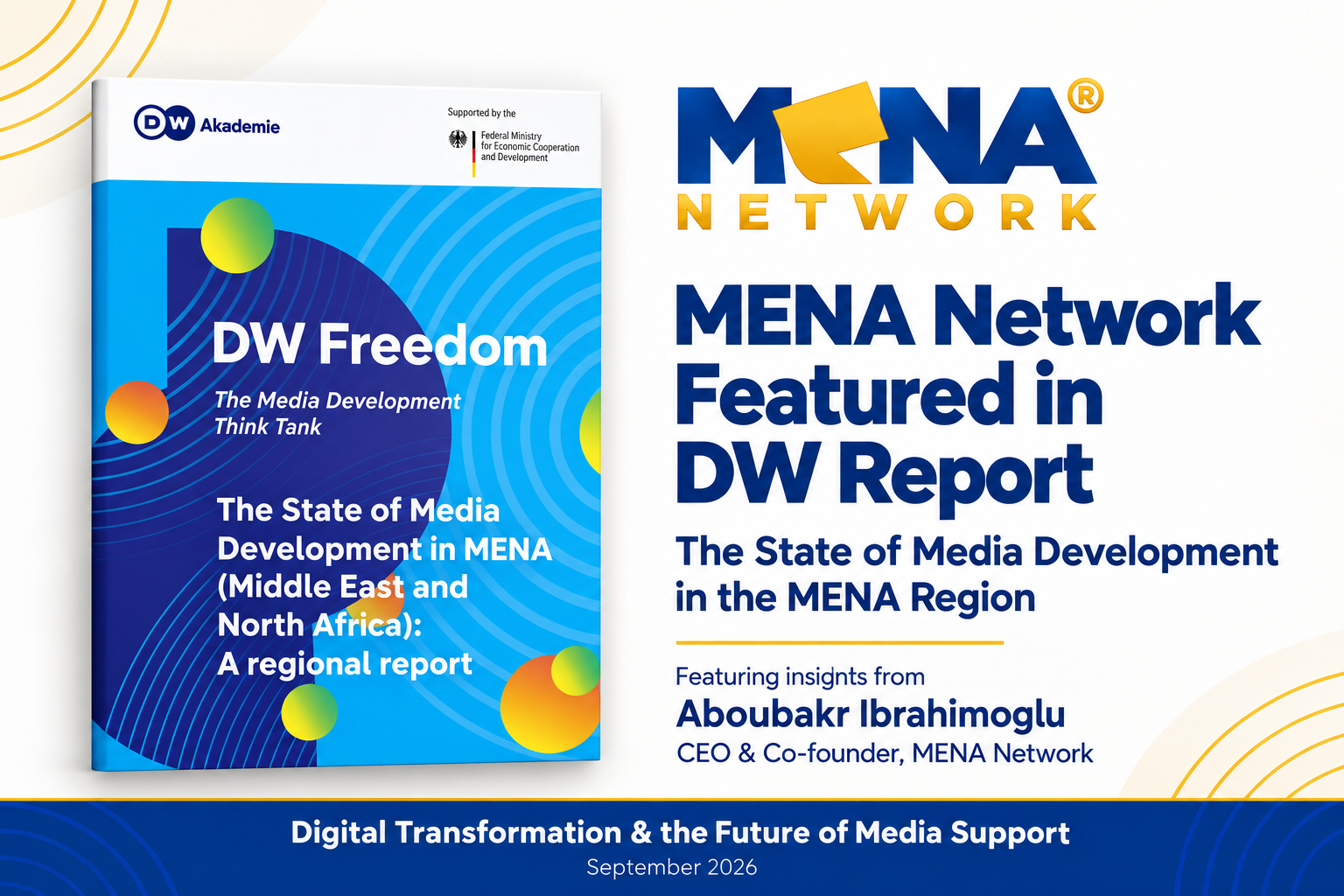
Aboubakr Ibrahimoglu highlights the digital support gap and barriers to international participation, as the report examines funding, local leadership, and technological change.
MENA Network | Reports
MENA Network® contributed its perspective to The State of Media Development in MENA, published by DW Akademie in September 2026. The report features insights from Aboubakr Ibrahimoglu, CEO and Co-founder of MENA Network, alongside interviews with ten media development organizations and a survey involving eight organizations. Research took place between December 2025 and February 2026.
For MENA Network, this contribution brings practical regional experience into an international discussion with direct implications for journalists: how can media support respond to professional needs while keeping pace with changing audiences and technologies?
Ibrahimoglu: Media Support Must Follow the Digital Shift
“The key impact now comes through social media and digital platforms,” Ibrahimoglu told the researchers, highlighting a gap between digital audience behaviour and European support organizations’ continued focus on traditional media.
His observation raises an important question for programme design: does support reach the spaces where people actually encounter news and information?
In practical terms, introducing digital tools is only one part of professional development. Journalists also need the editorial judgement to decide when and how to use them, the ability to verify material circulating online, and a clear understanding of their responsibilities to audiences.
This also creates a case for closer professional engagement with content creators who share news and public-interest information. The appropriate approach will vary according to their work, but accuracy, transparency and correction remain useful foundations for that engagement.
International Participation: Beyond an Invitation
Ibrahimoglu also described obstacles to attending European conferences, including limited speaking opportunities, travel expenses and visa procedures that can take four to five months.
These barriers invite closer scrutiny of how international discussions are organized. An invitation provides access; a meaningful speaking role allows participants to explain their experience, challenge assumptions and influence the agenda.
Earlier planning, transparent speaker selection and appropriate participation budgets would help organizers include professionals whose knowledge comes directly from working with journalists and institutions across the region.
Key Findings: Financial Pressure and Unequal Partnerships
The report identifies interconnected pressures: shrinking funding, insufficient flexible institutional support, limited local involvement in programme design, escalating disinformation and the need for responsible AI adoption.
Read together, these issues point to a broader management challenge. A training programme needs an organizational setting in which its lessons can be applied: editors who provide feedback, accessible tools, time for review and the ability to retain experienced staff.
Partnership quality also deserves examination through concrete questions. Who defines the problem? Who selects the participants? Who decides whether the programme has worked? Discussing these questions at the outset can make cooperation more accountable and responsive.
The Numbers—and Their Limits
The report records that 67% of organizations covered by its project-duration indicator had average projects lasting a year or less. Fewer than 30% of seven respondents reported a meaningful role in setting priorities, while 75% supported non-traditional media actors. These figures describe the research sample, rather than the entire regional sector.
Their value lies in the questions they help institutions ask about their own practices: Is the funding period appropriate? How substantial is local participation? Do programmes reach people who shape information flows?
Recommendations and Practical Implications
The report recommends flexible institutional funding, operational and safety budgets, local participation in programme design, diversified revenue, stronger verification capacity and ethical AI policies.
For organizations considering their next programme, these priorities offer a starting point for practical evaluation. Will the initiative leave lasting capacity? Are the tools needed to apply the training available? Does the partnership protect editorial decision-making? Can local teams propose changes when circumstances shift?
Answering those questions requires dialogue between funders, programme managers, editors and working journalists. It also requires attention to what happens after an activity ends, when participants return to their daily professional responsibilities.
Bringing Regional Experience into the Discussion
MENA Network’s contribution connects this international debate with the experience of a regional professional network. Its significance lies in making that experience available for scrutiny and discussion, particularly on digital change and access to international forums.
The next step for the wider sector is to turn such exchanges into better decisions about resources, skills and participation—decisions that help journalists produce reliable information and serve their audiences.
Sources: DW Akademie’s published article and the full regional report.